

You are here: Benchmark Home » Real Estate Market » Page 4

Category: Real Estate Market

New House

Jump in New Home Sales Highest Since 2008

New House
According to a press release from the U.S. Department of Housing and Urban Development and the U.S. Census Bureau, new single family home sales in June grew by 3.5%* over May, and 25.4%** over June 2015. The seasonally adjusted annual rate was 592,000 in June, and 572,000 was the revised rate in May. The rate in June of last year was estimated to be 472,000.

Economists Weigh In

June 2016 is the highest new single family home sales we’ve seen since February of 2008, according to Ralph McLaughlin, Chief Economist for Trulia, who writes, “This is a continued sign that demand for homes remains solid and aptly reflects increasing homebuilder confidence.”

Brent Nyitray, a Chartered Financial Analyst specializing in economics and financial markets, said, “New Home Sales rose to 592k in June, much higher than the Street expectation. The median new home price rose 6.1% YOY to $306,700. There is about 4.9 month’s worth of inventory right now, compared to 5.1 months in May.” (read more)

Home Prices Rose

In June, the median new home sale price was $306,700, with the average sales price at $358,200.

Home prices nationwide rose 5% in May (compared to May 2015), according to the CoreLogic Case-Shiller Indices.

The Takeaway

New Home sales have seen an increase since last year, and since last month, with the highest numbers since February of 2008, 100 months ago. This has surpassed expectations, and signals that demand really is the driving force in the housing market. With the inventory at only 4.9 months, compared to 5.1 months in May, low housing inventory is still driving values up.

With inventory shrinking, home values are likely to increase. With rates still low, it’s a great time to buy. Call us today!


*(±23.9%), **(±27.9%) – 90% confidence interval includes zero. The Census Bureau does not have sufficient statistical evidence to conclude that the actual change is different from zero.


EU Referendum Result graphic #Brexit

The EU Referendum, Brexit, and US Mortgage Rates

“The sudden stop in employment growth rules out any chance of a rate hike from the Fed at next week’s FOMC meeting, particularly now that the UK vote on whether to leave the European Union appears to be going down to the wire,” said Capital Economics Chief Economist Paul Ashworth.  (source: Housingwire.com)


Britain’s exit from the EU increases the value of the dollar, which will push U.S. mortgage rates still lower. “This would create another mini refinance mortgage boom at financial institutions as homeowners rush to lock in near-historic low interest rates,” says Steve Rick, chief economist for CUNA Mutual Group. (source: Bankrate.com)

Fed Not Expected To Raise Rates

As Paul Ashworth indicated in his quote in HousingWire, The Federal Open Market Committee (who determines monetary policy of the Federal Reserve) is not likely to raise interest rates in their next meeting in July.

Futures dropped in the wake of the UK’s vote to leave the EU today, June 24th. This lack of confidence puts more pressure on the FOMC to, once again, postpone a rate hike.

US Dollar Strengthens as Pound is Pummeled

The pound fell to near 1985 levels, making it the lowest value in three decades. According to the Federal Reserve of St. Louis, 1GBP is now down to 1.37USD. (source: WashingtonPost)

When our currency is worth more, it has more purchasing power, which is cause for suspecting that this could make the cost of housing cheaper still.

Is a refinance boom coming? That remains to be seen, but with the relatively high supply in the housing market coupled with a stronger dollar, we may begin to see the supply begin to normalize as homeowners cash out on their accumulated equity.

The Takeaway

No matter your opinion of the EU Referendum result, mortgages are still, historically speaking, ridiculously cheap.

Mortgage prices tend to follow Treasury yields, which have been trending down all year, too. Last week, the interest on 10-year Treasuries dropped to its lowest in four years on worries that Britain would vote to leave the European Union. When the political and economic outlook is uncertain, the world’s money tends to flow into safe investments like U.S. bonds, including mortgages. – Loraine Woellert, Senior managing editor for Redfin research (source: Forbes.com)

Notes:

Is More Housing Inventory On the Way?

Is More Housing Inventory On The Horizon?

Is More Housing Inventory On the Way?
There has been a lot of talk about the rising value of houses in recent years. While some have expressed concern over another 2008 style housing bubble forming, we have dispelled this notion. While economics is a bit more complicated, most moves are the direct result of what you may have learned in school: supply and demand.

The Buyers are Vying

While no-one doubts that the current economy is sluggish (with varying opinions as to why), the demand for single family homes has continually increased. To corroborate that this is not just a timely fad, surveys show that 80%+  still considers home ownership an essential part of the American Dream. (something that we have talked about before). A recent Gallup survey indicates that real estate is considered to be the best long-term investment.

The Owners are Holding

For several years, homeowners may not have been able to sell. Reasons were numerous, including issues such as family finances and lack of home equity. (which isn’t surprising, in the wake of a housing bubble collapse) As a result of this “holding”, the supply of homes is low, as is to be expected. With the steady increase in home values, however, there is reason to believe that incrased motivation to sell will possibly increase the supply. Do families want to sell?

Short of asking, we can look at how long homes have been held, on average, over time.

Forbes


As the economy continues to improve, even if slowly, and more families approach possession of significant equity (20% or more), we expect to see more homes on the market. As the supply increase reduces the gap with existing demand, home price increases may begin to slow.

The Takeaway

If you are one of those who have been holding onto your current home over the last few years, now may be a good time to cash in (sell), and find the home of your dreams.

Sold on for-sale sign in front of house.

Low Housing Inventory Driving Values Up

Many people may have been watching home values steadily rise over the past year, and notice that it isn’t slowing down.

Another Housing Bubble?

Is this the aftershocks of 2008? Has sub-prime lending made a comeback as the Federal Reserve has hesitated to raise interest rates? Are new homeowners soon to be upside down on their young mortgages? No. Some have speculated it. Don’t believe it.

Purely Supply and Demand

After the bubble crash 8 years go, demand dropped first, then supply followed. In the market’s rebound correction (that we are still in the middle of), demand is driving the housing market once again.

In this case, demand growth is outpacing the housing supply. The result? More people want the housing that is available, and the competition drives up market value.

While this does make it a difficult time to buy, it may also be a terrific time to sell!

What’s A New Buyer To Do?

When prices are going up, and are projected to continue to increase, it is good to remember that interest levels are still low. This is when it makes sense to consider the true cost of waiting.

True Cost of Waiting

Consider this:

If you were to buy a house right now, with a $250,000 mortgage at 3.68%APR interest, your Payment (P&I) would be $1,147.88

If you were to buy the same house Between January and March (estimate) in 2017, your same mortgage would be $263,750 at (estimated) 4.5%APR interest. Your Payment (P&I) would be $1,336.38

By buying now, your net worth would automatically increase by $13,750 (not including the principle payments that you would be making to shrink the balance/increase your equity)

The difference in monthly payment would be $188.50. Can you afford an extra $188/month in exchange for… uh… well… …hesitation?

Over the course of 30 years, you would end up paying $67,860 more as a result. What could you do with an extra $68k?

Lock It In, And Watch It Climb

The general convention, as we have mentioned before, is to buy as early as you can. You may be better off in terms of both equity and housing costs.

Ready to get started? Give us a call!

2016 Mortgage Interest Rate Outlook graphic

Home Prices and Mortgage Interest Rates to Rise in 2016

Your home’s mortgage payment is based on the price of the home (minus the down payment), and the interest rate for the loan.

Both prices and interest rates will likely rise in 2016.

Home Prices

CoreLogic anticipates a national 5.2% home value increase for the next year. The percentage varies by state, with WA, CA, NV, UT, AZ, NM, FL, and VT seeing the greatest increase at an average of  7.6% (the highest being CA at 10.8%, the lowest of this group being NM at 6.0%). The lowest forecasted home price increase is WV at 1.3%.  Clearly, the majority of the country is projected to see a real home value appreciation that outpaces currency inflation (0.5% from 2014-2015).

Which reminds one of this post: click here

Mortgage Interest Rates

All four establishments who provide future projections on mortgage interest rates agree that rates will rise in 2016. The following table shows the change for each quarter of the next year.

Quarter Fannie
Mae
Freddie
Mac
MBA NAR Average
of all four
2016 1Q 3.9 4.0 4.2 4.1 4.05
2016 2Q 4.0 4.2 4.4 4.3 4.23
2016 3Q 4.0 4.4 4.6 4.6 4.4
2016 4Q 4.1 4.6 4.8 4.9 4.6

So, What’s the Bottom Line?

Since home prices and interest rates expected to increase over the next year, it makes sense to buy sooner rather than later, if you are buying a new home.

placing coin in piggy bank photo

Homeowner Average Net Worth 3,600% Higher Than Renter

Not only has the housing market made a strong economic recovery, but also in consumer and expert confidence in home-ownership as an investment.

Not Because of a Difference in Lifestyle

In the New York Times, an editorial entitled, “Homeownership and Wealth Creation” explains:

“Homeownership long has been central to Americans’ ability to amass wealth; even with the substantial decline in wealth after the housing bust, the net worth of homeowners over time has significantly outpaced that of renters, who tend as a group to accumulate little if any wealth.”

The Federal Reserve’s Own Research Agrees

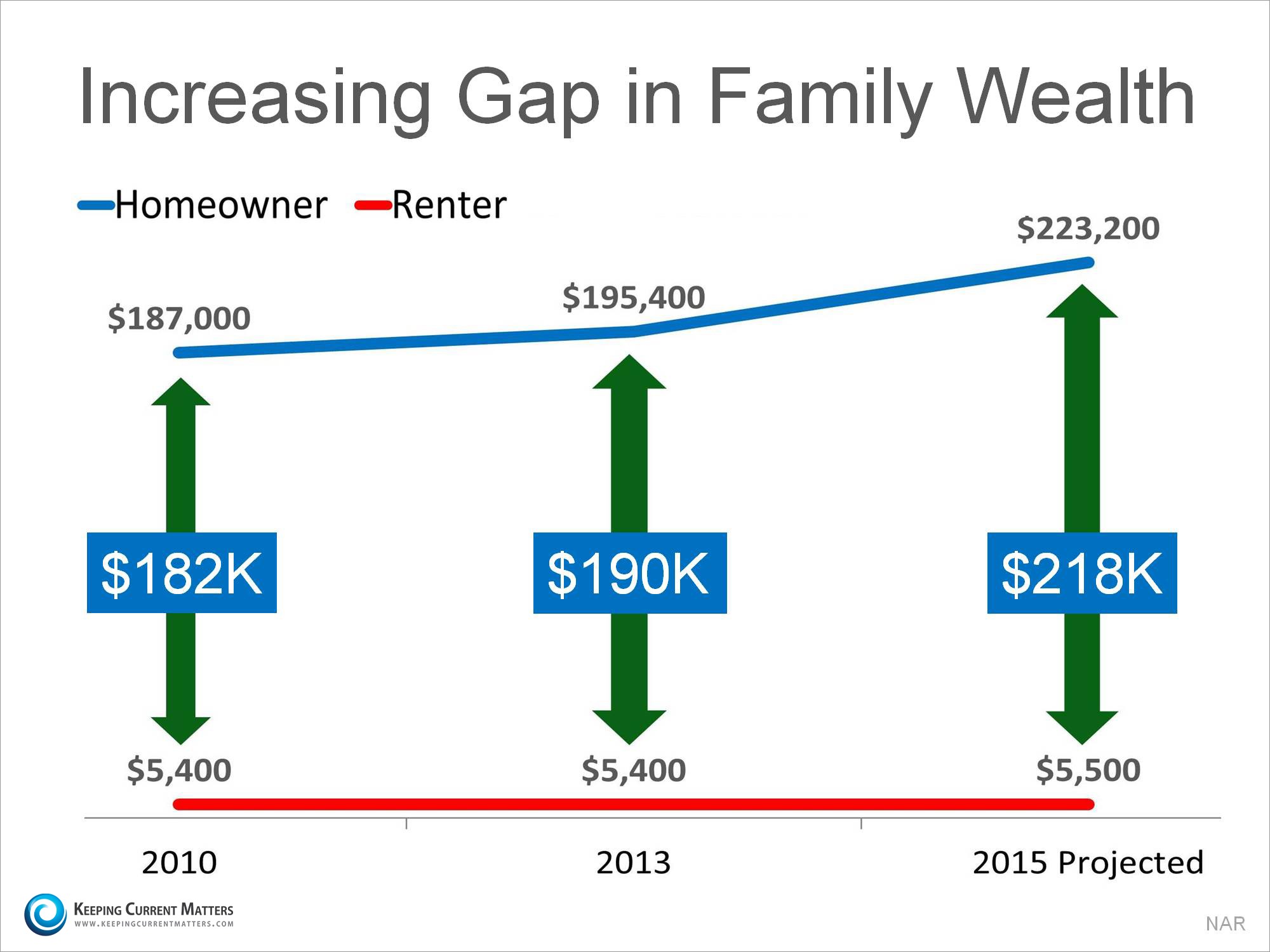
While we have referenced this article before, many of the claims that the article makes are backed by the research that the Federal Reserve has conducted in their Survey of Consumer Finances. The study found that,

the average net worth of a homeowner ($194,500)
is 36x greater than that of a renter ($5,400).

The National Association of Realtors (NAR) expanded on the Federal Reserve’s research and projected that,

by the end of 2015, the average homeowner will have nearly
41x the net worth of a renter.

That’s nearly 4,100%!

The Gap Widens

Their findings are detailed in the graph below:


One reason for this large discrepancy in net worth is the concept of ‘forced savings’ created by having a mortgage payment and was explained by the New York Times:

“Homeownership requires potential buyers to save for a down payment, and forces them to continue to save by paying down a portion of the mortgage principal each month.” “Even in instances where renters have excess cash, saving a substantial amount is difficult without a near-term goal, like a down payment. It is also difficult to systematically invest each month in stocks, bonds or other assets without being compelled to do so.”

The Takeaway

“As a means to building wealth, there is no practical substitute for homeownership.”

If you are a renter who is considering making a purchase, talk with a Benchmark Mortgage professional who can explain the benefits of signing a contract to purchase over renewing your lease.

click here to find yours

A good realtor has the heart of an educator graphic

Find A Great Real Estate Agent The Easy Way

Looking to buy or sell your home? You may have noticed the vast amount of information available in the news and on the internet about real estate. When trying to make sense of it all, one can easily get overwhelmed or confused.

You need an agent who can help navigate the current housing market. If you are looking to sell, you need an agent who can help you price your home correctly and appropriately. If you are looking to buy, you need an agent who can help you determine what to offer on your dream home (without overpaying or offending the seller with a below-market offer).

How high should you price your home? How much should you offer on a listing? A great agent can help you determine these numbers, and help you come out on top.

Financial guru Dave Ramsey says,

“When getting help with money, whether it’s insurance, real estate or investments, you should always look for someone with the heart of a teacher, not the heart of a salesman.”

An Agent Who Knows Your Market Can Make Your Experience Easier

We admit, this seems rather obvious. But, how do you know whether an agent is really up-to-the-minute on what is happening in your real estate market? How do you know if they will take the time to simply and effectively explain what it all means and how it may affect you?

A simple way to find out is by searching through a real estate agent’s social media channels. What kind of material are they sharing? Are they using their social media platforms to share current, helpful information or are they just posting trendy recipes and inspirational quotes?

The best agents spend time educating and informing so you can be confident when buying or selling your home. What they share online will help you to determine whether an agent meets the description advised by Dave Ramsey above:  

“…you should always look for someone with the heart of a teacher.”

Do you know a great agent like this? What other tips do you have for us? Share this article with your additions.

do's and don'ts for the mortgage process around christmas graphic

Do’s & Dont’s for the Mortgage Process around CHRISTMAS

The holiday season is always a crazy time, but that’s no reason not to take advantage of the great housing market, and make some new holiday memories in a new home. Benchmark is committed to a smooth and easy mortgage process, keep these simple do’s and don’ts handy as you start your home buying process this holiday season.

DO’s:

· Keep an eye on your holiday budget; remember not to make big purchases that might affect your credit score.
· Be sure and take into consideration your own personal schedule as the holidays tend to get hectic quickly.
· Use your neighborhoods Christmas decorations to gauge the atmosphere of the community.
· Call your Benchmark mortgage professional l to start your home search today! Nothing is better than a Christmas spent in a new home!
· Remember it is the holiday season for your loan officer and realtor. While they will gladly assist with any questions you might have, be mindful of their time.
· Let Santa and the Elves know that you have moved addresses!

DON’TS:

· Don’t make any large purchases (things that require credit checks or opening new lines of credit). This can affect your credit score and change your loan status.
· Don’t wait until the last minute to complete and send the required documents to your loan officer. Doing it in a timely manner will ensure a smooth loan process.
· Don’t rush putting an offer on a house just because you can close before the holiday season. Remember, this is a long-term decision.
· Don’t use your entire down payment on holiday gifts. Save the money you can.
· Don’t accept monetary gifts from relatives without consulting your loan officer first. (Monetary would be like down payment assistance)