You are here: Benchmark Home » Archives for bmadmin » Page 9

Author: bmadmin

Low Interest Rates vs. Economy Jitters [VIDEO]

Historically low interest rates combined with incredible deals on real estate have created the perfect time to buy a home.

“If you don’t own a home, buy one. If you own one home, buy another one. And if you own two homes, buy a third and lend your relatives the money to buy one.” -John Paulson

Check out this video from CNBC.com about the current real estate market and why renters should seriously consider homeownership.

What If You Could Buy Shoes…

What if there was a shoe store that had:

  • An unparalleled selection of shoes of every size, color, and price range
  • The shoes were discounted 30% or more
  • You had a credit card that would finance the shoes for 30 years at 4.5%

How many shoes would you buy? My bet is there would be a line around the block. Well, today, real estate is like that shoe store (incredible selection, terrific bargains and excellent financing terms). But there’s more….

  • Shoes go in and out of style. Homeownership is still the American Dream.
  • Shoes are worth less once you wear them. Homes will appreciate in value over time.
  • Shoes get disposed of. Homes are lasting.

And while many can recount memories created in certain shoes, everyone can remember their first home, their first family gathering, the countless holidays shared. There is also the ability to decorate to your tastes, the stability (and lower crime rate) in homeownership neighborhoods and the higher level of education achieved by kids who grow up there.

If you’d stand in line to buy shoes, what’s stopping you from exploring a home? Despite some media perceptions, there is mortgage money available with reasonable down payment requirements at extremely low rates…talk to a loan officer. There are some great deals out there with short sales, foreclosures and regular transactions also!

Happy Shopping!

The Five Best Ways to Use LinkedIn

LinkedIn has tools and resources that can help you boost your career and build a professional network of friends and business associates.

There are over 100 million registered users on LinkedIn, which unlike other social media platforms, is focused on professional relationships and business contacts.

Here are five ways to take advantage of what the LinkedIn site has to offer:

1. Find a Job. LinkedIn is a favorite haunt of recruiters and headhunters. Career sites such as TheLadders or Monster are nice too, but LinkedIn adds the element of networking. You can let potential employers know about your skills and background through your LinkedIn profile – just as if you were posting your resume on a job site – but it also helps when you can get a credible referral through your LinkedIn network.

2. Build professional relationships. Success or failure can often be measured by the size of your Rolodex (or Google contacts). LinkedIn provides a platform for you to branch out and make new connections within your field or your company, and to leverage your connections’ connections when necessary.

3. Conduct research. LinkedIn can be an invaluable tool for gathering information. Its search tools support searches for LinkedIn members in a particular industry, or for a specific company. You can also research a company before you go in for an interview or accept a job with a new company.

4. Seek advice. You can use LinkedIn Answers to pose a question – big or small – to your entire LinkedIn network. Whether you’re trying to decide which laptop is best or you want advice on the best photo editing app on a smartphone, you can turn to your network of business professionals for guidance.

5. Establish a community. You can form a group on LinkedIn dedicated to a specific topic or industry, and then invite others to join that group to debate, discuss, and share ideas. Such a  group is also an opportunity to demonstrate your own knowledge and expertise by sharing what you know.

While you can do many of these same things on other platforms, such as Facebook or Twitter, LinkedIn lets you focus on professional business relationships using the rich set of tools available to LinkedIn members.

The 8 “Hottest” Indoor Summer Activities for Kids

August is here and summer is heating up, so we’re bringing you the 8 “hottest” indoor summer activities. Everyone loves going to the park, throwing a Frisbee, or swimming, but here are some ideas for those days you want to stay inside:

Have a Movie Day – Your kids will love the time spent cuddled up on the couch watching their favorite movie and eating popcorn. Who knows, you might enjoy it so much, it becomes a regular thing.

Paint a Picture – 2 pieces of posterboard and some kids paint can make an afternoon fly by. Take a snack break and have a special treat.

Go Bowling – Many bowling alleys have specials during the week or during work hours. Strap those ugly shoes on and go for it.

Taste Test – Put on blindfolds and figure out what different sauces are. This is fun with fruit too.

Put Together a Puzzle – Dig one of those old puzzles out of the back closet and get everyone to the dining table to help.

Cook Something New – Help your kids be self sufficient and teach them how to cook. Today is great day for a new recipe.

Go Window Shopping at the Mall – Walking around the mall can be fun and great exercise. If you can resist the sales, it can be very cheap too!

Play Go Fish – Do you have any Jacks? No, go fish. This is an all time favorite.

America’s Ugliest Homes

One way to make money in residential real estate: Buy the worst house in the best neighborhood you can afford — and then fix it up.

HomeVestors, which buys beat-up homes and resells them, is trying to find the ugliest of them all in its annual contest, which ends later this month.

Many of this year’s Ugliest Home candidates don’t look too unsightly from the outside, but a quick peek behind closed doors reveals some truly horrible conditions.

Buyers shouldn’t be too deterred by the chewed-up kitchen cabinets or flood-damaged floors, however. Buying a beat-up property can be a lot cheaper than buying one in A-one condition — as long as the damage isn’t too extensive.

Of course, it’s prudent to get an accurate estimate of what repair and renovations will cost before taking the plunge. The cost of fixing a cracked foundation or bad plumbing can wipe out any benefit of buying the fixer-upper on the block.

Here are five candidates in the running for HomeVestors’ Ugliest Home in America contest. Almost all of these homes have been bought by HomeVestors franchisees or clients and renovated. There truly is life after ugliness.

Chicago, IL
Status: Renovated
Ugly price: $45,000
Restored price: $162,000
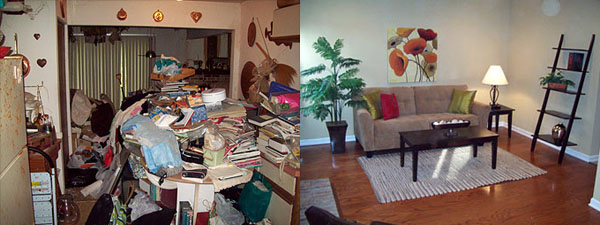
 

After filling 3 huge dumpsters this Chicago home cleaned up nicely.
Photo: HomeVestors


The Chicago area is a moderately-priced market but when a two-bedroom, two-bath townhouse is in as bad condition as this one was, the value can plummet.

Despite the separate dining room, the balcony off the master bedroom and the nice yard, this home sold for a mere $45,000.

Why so cheap? The interior was a disaster. Junk was piled shoulder high in some spaces. It took three, 40-foot-long dumpsters to get rid of it — and that did not include construction debris, reports the buyer, Alan Washer, a HomeVestors franchisee.

Washer completely rehabbed the house and replaced the wiring and heating systems. He put in all new interior doors and hardware, hardwood floors, bath tile and fixtures, windows and molding. All told, it took six months to complete the job.

Even after deducting for expenses, the deal was profitable: Washer sold the home for $162,000.


Frisco, TX
Status: Refreshed
Ugly price: Not applicable
Restored price: Not applicable
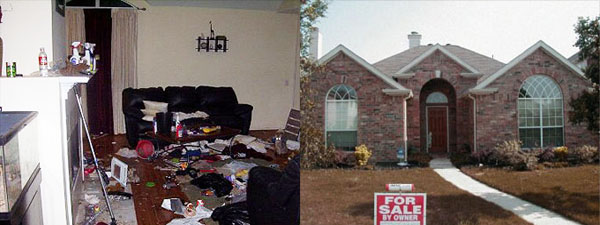
 

The renter in this Frisco, TX home left behind a huge mess but the outside looks good.
Photo: HomeVestors


The owner of this vintage house north of Dallas, Robert Pittana, nominated it for the Ugly Home contest himself because, he said, “I had never seen a house that ugly before.”

Really though, the place has all the attractive exterior accouterments of a home buyer’s dream: an arched entryway and windows, solid brickwork and a fan-light over the front door. Inside, though, it was another matter.

Pittana had rented the house to someone who “went off the deep end,” he said. Neighbors informed Pittana that they saw five or six cats trying to get out of the house. When he entered, he couldn’t stay long: There were cat feces everywhere, even on the ceiling.

The fix included stripping out the carpets and floors, bleaching walls and repainting. He brought in an ozone machine for several days to drive out the stink. Pittana still owns his ugly home, but it’s a lot easier on the eyes and nose now.


Englewood, CO
Status: Renovated
Ugly price: $76,000
Restored price: $110,000


This Englewood, CO abode just needed a good clean-up.
Photo: HomeVestors


The ugly duckling on a block of well-kept homes, this was a sad little two-bed, two-bath ranch house that sold for less than half as much as other similar homes in the neighborhood.

The home’s biggest problem was its owner, a hoarder. Floors, cabinet tops and other surfaces were piled with junk, much of it soiled and worthless.

Once the buyers got rid of the junk, exterminated all the pests and eradicated the molds, the home only needed some cosmetic repairs and replacements, which were done in just a few weeks.

The house was resold for $110,000, up from the $76,000 paid for it in this condition and retook its rightful place among the other tidy homes in the community.


Teaneck, N.J.
Status: Renovated
Ugly price: $180,000
Restored price: $330,000
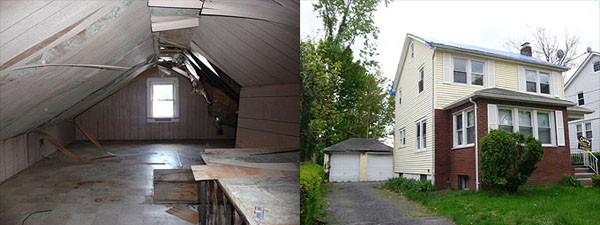
 

Roof leaks took a heavy toll on this Teaneck, N.J. home – but now it’s better.
Photo: HomeVestors


From the street, this bank-owned property looked pretty good: a modest wood-framed colonial with a small yard and a two-car garage. Inside was another story.

The roof had leaked for years and rainwater had rotted out many of the home’s structural elements — all the way to the basement. The plaster ceilings and walls were un-salvageable and ugly thick mold was growing all over the damp spots in the house.

The buyers had to completely restore the home with new floors, sheet rock, paint and woodwork. The baths were done with tile and the kitchen with granite counters, cherry wood cabinets and stainless steel appliances.

Teaneck, N.J., where this home is located, is a short hop to Manhattan and home prices are relatively high, averaging about $350,000, according to real estate website Zillow. The buyers only paid $180,000 for this home. After they renovated the place, they sold it for about $330,000.


Shirley, MA
Status: Renovated
Ugly price: $41,915
Restored price: $174,500
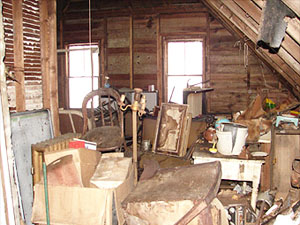
 

An ugly duckling home can become a swan.
Photo: HomeVestors


This was a handsome old house, one of the nicest in town, with a rocking-chair front porch and roomy interiors. But then the former owner lost his job, according to the local HomeVestor franchisee, Michael Jordan, and “The mounting bills and upkeep on the home became too much.”

Jordan and his brother, a contractor, bought the home for less than $50,000 and embarked on a total renovation. One of the biggest problems was the amount of debris. Jordan filled dumpsters with junk, including two pianos and several arcade games.

The home needed a lot: a new roof, heating system and the floors were a wreck. All the windows had to go. The Jordans also added a bathroom and put in a new kitchen. The rehab cost about $90,000.

They resold it at a small profit. But almost as important, said Jordan, is getting rid of an eyesore for the neighborhood.

Originally posted on money.cnn.com

Assets and Your Mortgage Application

When lenders evaluate mortgage borrowers, we look at four things: income (the ability to repay), credit (the willingness to repay), collateral (appraised value and property condition) and assets (cash in the deal and cash reserves after closing, mostly). Of the “four legs of the table”, assets are the least discussed, and yet may be the most important.

What do we mean when we talk about assets?

  • Monies needed for the down payment (the difference between the purchase price and the loan amount which may or may not be the same as the money deposit at contract signing)
  • Monies needed for closing costs (fees to the lender and third parties for things like appraisals, title insurance, settlement services, and so on)
  • Monies needed for Pre-Paids (homeowners insurance, flood insurance, real estate taxes, etc.) and establishing escrow accounts for future payments
  • Monies for Reserves– the money you still have left after closing. Monies that would be available, if a problem were to arise

Why do we care about assets?

  • Assets may be the truest reflection of a borrower’s fiscal strength. Their ability to save and properly budget could be a significant indicator to their future paying habits
  • The source of the assets is important. Savings? Gift or inheritance? Lottery victory? Insurance settlement? Sale of a baseball card collection? Each reflects differently on the borrower.
  • Many people don’t show all their income on their tax returns (it’s just a fact). Undocumented income can’t be used to qualify; however, often assets become a truer representation of a borrower ability to pay than their 1040s.
  • Reserves are an issue. A client with $50 in the bank after closing is riskier than one with $50,000. Also, clients who have money in the bank but have some sporadic lates on their credit are looked at differently than those who didn’t have the money to make the payments.

Common Asset Issues in Mortgage Packages:

  • Large deposits (defined as those which are excessive for the income level) raise an underwriter’s eyebrows. Where did the money come from? Maybe the borrower took a loan that doesn’t yet show up on their credit report.
  • Cash deposits are another red flag. In this day and age, people keep their money in the bank, not under their mattress. Where did the cash come from?
  • Gift monies and seller’s concessions, while considered as borrowers assets when doing calculations, will give an underwriter pause when assessing the borrower’s real ability to replay.

Guidelines have tightened. When borrowers are paying off credit cards to get their ratios in line, lenders are asking where that money came from now. That act has nothing to do with the home purchase, but may be a sign of something fragile in the borrower’s financial make up.

The best advice is to consult a loan professional to discuss the proper way to position your assets and the timing of it that will put you in the most favorable light.


3 Tips to Getting the Best Home Insurance

If you’re a first-time homeowner, you might be a bit intimidated by the prospect of looking for the best home insurance coverage to protect your investment.

With all of the different insurance companies out there, it can be confusing to know which coverage options you need and how to get them at the lowest possible rate.

What follows are three tips that will help you compare home insurance so you find the policy that’s right for you.

  1. Find out what the policy covers and for how much you’ll be covered. For example, if you live in an area that’s at risk for tornadoes, you need to check to see how much coverage you have for wind damage.
  2. Review the policy carefully to see if you need additional insurance for floods or valuable possessions. Homeowners insurance doesn’t typically include flood insurance, so find out how to include that in your policy. In addition, if you have a lot of valuable possessions, such as a collection of antiques or art, find out if the policy offers enough coverage, or if you need additional insurance.
  3. Rates are always an important point when it comes to insurance. Check the annual and monthly premium amount to see if it’s viable for your situation. Also check the deductible amount to see how much that is. Remember, you always have to pay the deductible amount yourself, so you’ll have to have that money available in the event of a claim before your insurance coverage helps out.


Are Banks Ready to Lend Again?

Major U.S. banks appear to be finally opening the lending spigot.

Second-quarter earnings reports due this month are likely to reveal a slight reversal of the long-term shrinkage in bank loan books, one of several positive signs for investors, bank analysts said.

…”Banks are beginning to lend again and that’s a good sign,” said Timothy Ghriskey, co-founder of Solaris Group, which owns bank stocks.

…Large banks are starting to loosen their standards for credit card applications, according to a Fed survey of senior bank loan officers in April…

Read the full article on reuters.com